Why Free Security Scan Tools Are a Serious Risk to Your Website
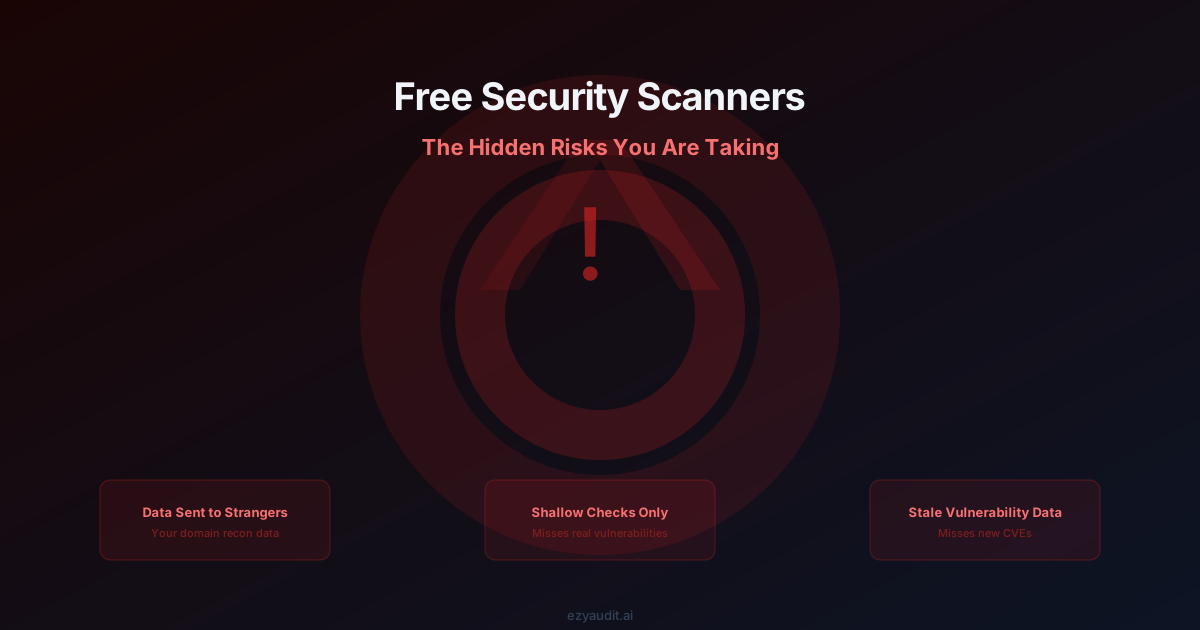
Free security scan tools look like a smart way to check your website, but they often introduce more risk than they remove. Here is why free security scan tools can become a serious security risk of their own.
Typing your domain into a free online scanner and watching a green “secure” badge appear is a genuinely good feeling. It’s also, very often, a misleading one. The badge is real. The reassurance behind it usually isn’t.
Free security scanners aren’t worthless — but the gap between what they appear to promise and what they actually deliver is wide enough to be dangerous. Here’s what’s really happening when the check comes back clean.
“Secure” usually means “we checked four things”
Most free scanners run a small, fixed set of surface checks: is there an SSL certificate, does the homepage load over HTTPS, are one or two common headers present. Useful, as far as it goes. But a modern website has dozens of meaningful attack surfaces, and the free tool is silent on nearly all of them.
It won’t fingerprint your plugins and themes to find versions with known, actively exploited vulnerabilities. It won’t check whether your DNS records let a stranger spoof your email. It won’t look for the exposed backup file or readable debug log that hands an attacker the keys. The green badge isn’t lying about the four things it checked. It’s just silent about the forty it didn’t.
A clean result from a shallow scanner is the most expensive kind of reassurance: it persuades you to stop looking at exactly the moment you should look harder.
Where does your data actually go?
When you submit your domain to a free service, it’s worth asking what happens next. Some legitimate tools simply run a check and forget you. Others log every domain submitted, build a database of sites and their weaknesses, and monetise that information through advertising, “lead generation,” or worse.
A list of websites paired with their unpatched vulnerabilities is a genuinely valuable asset — to marketers, and to attackers. If a service is free, it’s worth understanding how it keeps the lights on before you hand it a map of your soft spots.
Stale data, false comfort
Vulnerability data has a shelf life measured in days. New CVEs are disclosed constantly, and once an exploit is public it gets scanned for across the internet almost immediately.
Maintaining a current vulnerability database is expensive and unglamorous work, and it’s usually the first thing a free tool quietly skips. So the scanner checks your plugins against a list that hasn’t moved in months and reports no problems — while a critical flaw disclosed in the meantime sits open and unmentioned.
No context, no path forward
Even when a free tool does surface a real issue, it tends to stop at the diagnosis. “Missing security header.” “Outdated software detected.” Then nothing — no severity, no explanation, no fix. You’re left knowing something is wrong without knowing whether it’s urgent or how to address it, which for most owners means it never gets addressed at all.
When free is genuinely fine
To be fair: if you just need to confirm a certificate installed correctly, or do a five-second sanity check, a free tool is perfectly reasonable. The problem isn’t using them — it’s mistaking them for a complete picture and letting that green badge talk you out of a real assessment.
What a complete assessment looks like
A proper scan inspects every major attack surface, checks software against a vulnerability database updated daily, ranks findings by severity, and tells you in plain language how to fix each one. That’s the standard EzyAudit AI is built to: more than 40 checks in about 90 seconds, drawing on the CISA KEV catalogue and the National Vulnerability Database, with specific remediation steps for everything it finds.
Your first EzyAudit AI scan is free — the same deep checks as a paid scan, not a four-item surface check. If the free badge is right, you’ve lost nothing confirming it. If it’s wrong, you’ve just found out before an attacker did.
See how your website scores
Run a full 95-point security audit in 90 seconds. Get an A–F grade with exact fix steps for every issue found.
1 free scan · Results in 90 seconds · No credit card required
The hidden risks of free security scan tools
None of this means checking your site is a bad idea, only that free security scan tools are the wrong way to do it. Guidance from bodies like CISA makes clear that trustworthy tooling matters. Run a proper scan with EzyAudit AI instead and get results you can act on safely.